How Allicin Bio-Fungicides Protect Greenhouse Tomatoes and Cucumbers from Powdery Mildew
Powdery mildew is one of the most persistent fungal threats facing protected-culture vegetable growers. For producers raising tomatoes and cucumbers under glass or plastic, a single undetected outbreak can sweep through an entire house within days.
Rising residue limits and growing resistance to synthetic chemistry have pushed many growers toward botanical solutions. Allicin, a sulfur-containing compound derived from garlic, has attracted attention for its broad antifungal activity.
Research shows that allicin can interfere with fungal proteins, metabolism, and cellular structures. These properties make allicin a promising ingredient for botanical bio-fungicide development.
Why Is Powdery Mildew Common in Greenhouse Tomatoes and Cucumbers?
Greenhouses provide a controlled environment for crop production. However, the same environment can also support fungal disease development.
The pathogens that attack these crops—Erysiphe lycopersici on tomatoes and *Erysiphe cichoracearum on cucurbits—favor moderate temperatures of roughly 15–27 °C and high relative humidity.
Unlike many foliar diseases, their spores do not need free water to germinate; they actually infect most readily in dry-leaf, humid-air conditions. Dense canopy planting, repeated overhead misting, and limited natural air exchange inside a closed house all concentrate inoculum. Because spores travel on air currents, a focus starting on one bench can move quickly to neighboring rows.
According to the University of California IPM program, cucurbits such as cucumbers are among the most susceptible vegetable groups, making proactive prevention essential.
How Does Powdery Mildew Affect Tomato and Cucumber Production?
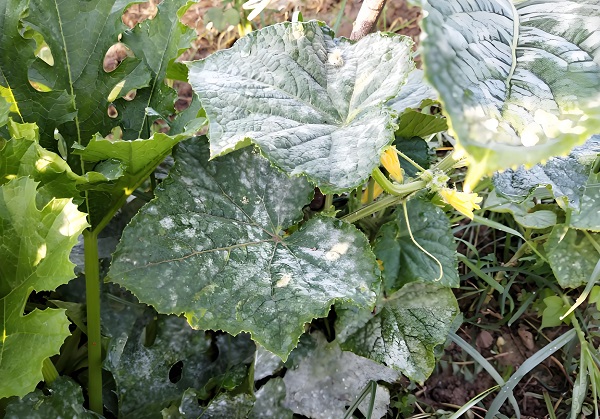
Left unchecked, powdery mildew forms a white, talcum-like colony on leaves, stems, and fruit. The fungal mat shades photosynthetic tissue, forcing the plant to divert energy from fruit set to survival.
In tomatoes, infected lower leaves senesce early, reducing yield and exposing fruit to sunscald. In cucumbers, colonized leaves curl, yellow, and drop, shrinking both fruit size and market grade.
How Does Allicin Work Against Fungal Pathogens?
Allicin is the principal antimicrobial compound formed when garlic tissue is disrupted: the enzyme alliinase converts the precursor alliin into allicin (diallyl thiosulfinate). Its antifungal power comes from a multi-target mechanism rather than a single site, precisely why fungi struggle to develop resistance to it.
- First, allicin is a highly reactive thiol-modifying agent. It binds covalently to sulfhydryl (-SH) groups on cysteine residues of fungal proteins and enzymes, disabling the machinery those proteins run. A 2024 study on tomato gray mold showed allicin binding directly to dihydrolipoamide dehydrogenase disrupting energy metabolism and inhibiting ATP production.
- Second, allicin breaches the plasma membrane, causing leakage of intracellular contents and loss of membrane potential.
- Third, it induces oxidative stress through reactive oxygen species and interferes with DNA, RNA, and cell-wall biosynthesis.
The combined effect halts spore germination, mycelial growth, and hyphal elongation.
How Allicin Bio-Fungicides Suppress Powdery Mildew on Greenhouse Crops
When stabilized allicin powder is formulated into a spray or misting concentrate, it delivers these actions directly to the leaf surface where powdery mildew establishes. Applied preventively or at the first sign of colonies, the active coats emerging mycelium and germinating spores, blocking the disease before it spreads across the canopy.
Because the compound acts on contact and through multiple biochemical pathways, it remains effective even where single-site synthetic fungicides have lost efficacy.
For greenhouse programs, allicin fits naturally into low-volume misting and fogging systems, providing uniform coverage of dense foliage without leaving problematic residues at harvest.
Why Allicin Is a Promising Botanical Alternative to Conventional Fungicides
Conventional powdery mildew control has long relied on sulfur, triazoles, and strobilurins—chemistry now facing resistance, maximum-residue limits, and re-registration pressure.
Allicin offers a different profile: it is a naturally derived, biodegradable molecule with a short environmental half-life and no known cross-resistance to synthetic modes of action. That makes it attractive for integrated pest management (IPM), organic-aligned production, and export programs with strict residue rules.
A standardized biological fungicide ingredient also supports clean labels and reduced worker re-entry intervals.
How to Apply Allicin Bio-Fungicides in Greenhouse Tomato and Cucumber Production
Timing and coverage drive results.
- Begin applications at transplant or at the first appearance of mildew, and repeat on a 7–10 day interval through high-risk windows.
- Use enough dilution water to wet both leaf surfaces, since powdery mildew colonizes the upper canopy first.
- Apply in the early morning or evening when humidity is higher and UV is lower, protecting the active compound and improving deposition.
- Avoid tank-mixing with strongly alkaline products, and keep spray suspension pH near neutral.
Because allicin works on contact, rotate it with complementary biologicals rather than relying on a single pass.
Pesticide manufacturers or raw material distributors can request quotes for customized formulations of bulk allicin powder.
Integrating Allicin into an Effective Greenhouse Powdery Mildew Management Program
Allicin works best as part of an integrated strategy rather than as a standalone solution. A practical program can include three steps:
- Combine it with cultural controls—proper spacing, ventilation, and lower night humidity—to slow inoculum buildup.
- Scout weekly and remove the first infected leaves.
- Use allicin preventively during the humid, mild stretches when Erysiphe pressure peaks, and alternate it with a mycoparasitic biological such as Ampelomyces quisqualis to broaden suppression.
This stacked approach reduces dependence on any single active and preserves the long-term usefulness of every tool in the rotation.
How to Choose a Reliable Allicin Bio-Fungicide Ingredient Supplier
Not all allicin is equal. The compound is chemically unstable—it degrades with heat, high pH, and exposure to amino acids.
When you evaluate a bulk allicin powder supplier, ask for verified allicin assay (HPLC), standardized activity, and stability data under accelerated storage.
For wettable or soluble formulations, attention should be paid to particle size consistency; additionally, the allicin supplier should provide comprehensive compliance documentation and Safety Data Sheets (SDS), as well as the capability to assist with product registration filings. Selecting a partner that offers not only raw materials but also technical guidance on formulation will help shorten your product’s time-to-market.
Contact our team to discuss specification sheets and sample quantities for your next formulation.
Related Allicin Sources
What Is Allicin Good For
Allicin vs Ethylicin in Agriculture: Key Differences in Mechanism and Performance
Case Study: Allicin in Organic Pest Control Solutions
Managing Bacterial Leaf Spot and Soft Rot in Fruit Crops with Garlic-Derived Allicin
Synergistic Effects of Allicin and Neem Oil in Integrated Pest Management
A Buyer’s Guide to Sourcing Botanical Pesticide Materials: Bulk Allicin Powder Supply Chain Insights
Environmental Safety Profile of Allicin: Soil Degradation, Ecotoxicity, and Non-Target Organisms
How to Combine Allicin with Other Botanical Pesticides for Maximum Synergy
Allicin for Soil-Borne Pathogens: Controlling Fusarium and Root-Knot Nematodes Naturally
Wholesale Allicin Powder Feed Additive For Distributors and Brands
Allicin Stability in Water: Challenges and Solutions for Agricultural Formulations
FAQ
Is allicin effective against powdery mildew on tomatoes and cucumbers?
Yes. Allicin disrupts fungal membranes and energy metabolism through multiple pathways, making it an effective contact botanical fungicide against Erysiphe and Leveillula species when applied preventively or at first symptoms.
How often should I apply allicin in the greenhouse?
A 7–10 day interval through high-risk, humid windows is typical, with full coverage of both leaf surfaces and rotation alongside other biologicals.
References
- Cheng, D., Liu, F., Li, D., Ma, Y., Zhou, J.-J., Wang, D., & Chen, Z. (2025). Allicin Binds to Cysteine Residues of Fungal Dihydrolipoamide Dehydrogenase to Control Gray Mold (Botrytis cinerea) of Tomato. Phytopathology.
- University of California Statewide IPM Program. Powdery Mildew on Vegetables. UC ANR. Retrieved from.
- Leontiev, R., et al. (2018). Allicin in Digestive System Cancer: From Biological Effects to Clinical Treatment. Frontiers in Pharmacology /PMC.
- Advances in Pharmaceutical Processing and Particle Engineering of Garlic Extract-Based Formulations for Antifungal Therapy (2024). MDPI.
- Biology Insights. Garlic’s Antifungal Properties: Allicin’s Key Role Explained.
- Science Insights. Can Garlic Kill Fungus? The Science Explained.